The comparison is lopsided before it starts. "Plastic bags" are a product category, and 100 Polypropylene Shopping Bags are among them: PP is plastic, and bags made from polypropylene are legally plastic carrier bag under EU rules. What separates the two is structure, not chemistry. On one side is a 12-25 micron polyethylene film, which is thermallywelded into a waistcoat shape at 5-8 grams per bag; on the other side is a a 60–100 g/m2 spunbond fibre web spun sticky fiber mesh, sewn or ultrasonic welded into a 25-70 gram tote bag.
One side of comparison is material, the other is category
Ask three people in a purchasing office what the difference is, and you'll get three answers, because it pits a polymer family against a class of products. Polypropylene is a polyolefin. The same is true of HDPE and LDPE. The comparison is closer to asking what the difference is between aluminum and metal.
Buyers actually compare four products: 12-20 microns and 5–8 g of HDPE blow wrap, 3-5 grams of extremely light LDPE bag, 60-100 grams per square meter a spunbond nonwoven tote, 25 – 70 g per squaremeter of non-woven fabric tote bag and 55-125 grams per square meter of composite woven bag.
The legal criteria for distinguishing the four materials are wall thickness and intent to reuse, not polymer name. Under EU Directive 2019/904, carrier bag up to 50 μm are light, bags up to 15 μm are very light, and bags over 50 μm are reusable and fall into a category that member states are prohibited from banning. A 70–90 g/m2 nonwoven panel is well above that, so "reusability" is its legal domain, not a slogan. The saying that doesn't survive is "it's not plastic."
The question is actually what comparison
Put four on a piece of paper, separate 100 Polypropylene Shopping Bags and film carriers by five to 10 times their mass, and place them on a thickness class according to the rules.
| Product | Structure | Typical quality | Categories under EU delivery vehicle rules |
|---|---|---|---|
| Truck, tank top | Blown PE film, 12–20 μm, hot-welded | 5–8 g | Lightweight, less than 50 μm |
| Production / bread bag | PE membrane, 8-15 microns | 3-5g | Very light, less than 15 μm |
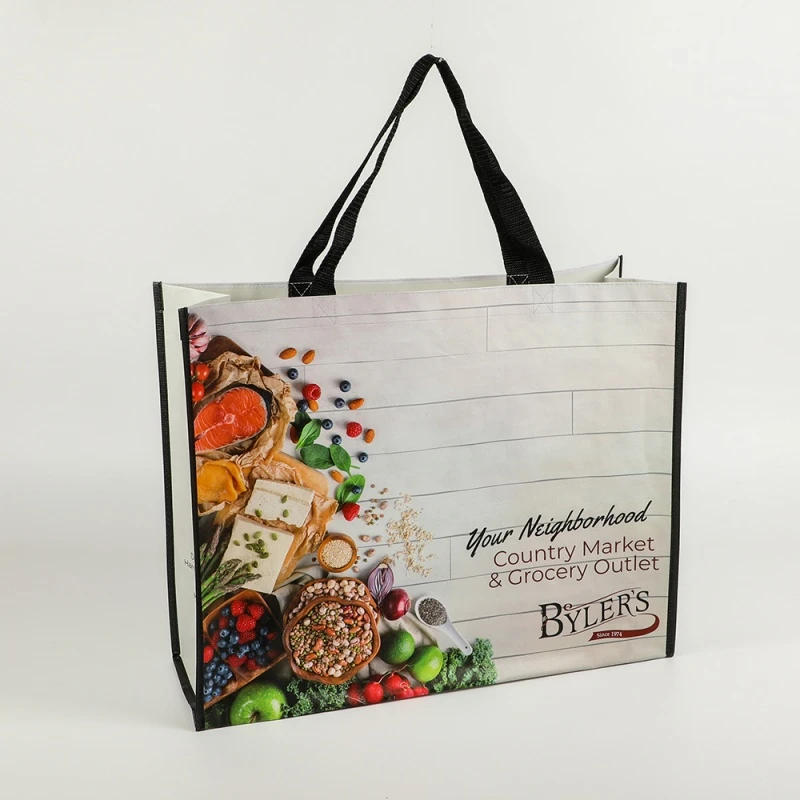
| Nonwoven tote | Spunbond PP web 60–100 g/m2 | 25–70 g | Reusable, 50 microns and up |
| Woven laminated sacks | PP tape fabric with Film | 60–150 g | Industrial packaging |
Reading the last column, the pattern is clear: this is not a material contest, but how many times each article will be written.
Same chemistry, different structure
100 Polypropylene Shopping Bags and film carriers come from a polymer family, so the differences between them must be explained structurally. Isotactic PP melts 0.90-0.91 g/cm3 at 160-170 °C; HDPE melts 0.94-0.96 g/cm3 at 125-135 °C; and LDPE melts 0.91-0.93 g/cm3 at 105-115 °C. There are four consequences in the workplace.
Stiff. PP's higher crystallinity of polypropylene, a higher modulus: a thermally bonded web maintain a frameless box shape and can be printed flat, whereas PE films require curtains and support.
Cold. PP embrittles near freezing, while HDPE is far less flexible than zero: where the membrane simply folds in the freezer aisle, a bag of frozen cargo tears at the base of the handle.
water. A nonwoven are hydrophobic but porous: resistance to water penetration is measured by a hydrostatic head, and a plain 60–80 g/m2 spunbond scores lower because the spider web is a web of gaps, not a wall. A 15 μm film has no pores, so the two films have different water-resistance mechanisms, not different degrees.
Print. Both are low surface energy and require corona treatment before ink can be maintained. Verify it with a wetting-tension test rather than a supplier statement and measure at the end of the roll: deal with decay in storage.
Loads are tested in the same way
The clearest way to compare the two cases is to test them against the same pass/fail rules on the same rig using a European standard. EN 13590 -Packaging-Flexible carrier bags used to transport a variety of retail goods. The carrier bags are covered with handles made of paper, thermoplastic material or any other flexible material, with or without buckles. It is a model test of at least 100 bags of normal production subject to EN ISO 2233 condition G at 23 + 2 °C and 50 ± 5% RH.
Volume is determined by bagging granules with a volume density of 500–600 kg/m3 bulk density and converting mass to litres. Load capacity is derived from the gradual loading and lifting of a rig with a manual grip of 0.65 ± 0.05 m/s, equipped with a HDPE cylinder with a diameter and height of 50 mm and a margin of 1 mm as specified in the attachment. When the bag passes, there are no holes larger than 30mm and no broken handles; handle elongation will be reflected in the report.
Shared testing exposes different fault sites. The thin-film vest carrier fails when welded or cut; a nonwoven tote fails at the handle attachment or the top seam-the practical answer to "which is stronger?"
The Reuse Arithmetic Behind the Choice
Such is the status of 100 Polypropylene Shopping Bags, arithmetic is more forgiving than marketing suggests. The 35x40cm tote bag has a 10cm fold and two handles, which consumes about 0.4 square metres of fabric; 80 g/m2, or about 32g g. A vest carrier non-woven fabric, and finished bags rarely lands below 25g or above 70g.
The standard is low, and it works both ways. A tote bag that returns 12 times was easy to clean; one that was used twice and stayed in the cupboard spent 32g PP on two trips, more than the five film bags it replaced. The bag itself doesn't determine the outcome-it's a retail question about whether the bag travels with the customer or stays at the checkout.
The useful life depends on two details. A 5kg bag can be turned into a 10kg bag without adding fabric, thanks to a striped nail or cross-stitch at the base of each handle and vibrating soldering rather than stitching at the fold. The next most frequent seam is when the field returns, the handle and seam fail long before the weave wears out.
What neither does
Both products have different claims, but neither holds water.
Both are uncompostable. EN13432 and ASTM D6400 have packaging requirements that can be recycled through composting, and polyolefin does not meet these requirements. Additives that break PE or PP bags into pieces are in the oxo-degradable class restricted by Directive 2019 / 904 (EU) and do not break down.
Neither is an obstacle. Food or liquids that do not stop smelling like perfume or oxygen, and are therefore not suitable for strong smells, are not lined. A non-woven tote can smell cooking, and the same net allows food to spill out.
Neither is recyclable. Collection was decisive, and density cannot allow for the classification of the two substances: polypropylene at 0.90-0.91 and polyethylene at 0.91-0.96 g/cm3 were floating in ponds. Near-infrared classification distinguishes them, which is why the identifier is important-it follows ISO 11469, every ISO 1043-1 has a symbol, it's something classifiers or consumers read.
Neither claim is free. Recycled content, biodegradability and similar assertions are self-declared environmental claims requiring certification as required by ISO 14021: the claim, the evidence and its scope of application.
How to specify suitable
Work from load and route, not from material label.
More than 5kg, with edged contents, or a bag that customers repeatedly bring home-a a 70–90 g/m2 spunbond tote or woven bag with reinforced handle roots.
Refrigerated or frozen contents, or route through the freezer-PE film, or polyethylene inner a nonwoven. Simple PP is on the wrong side of its brittleness.
Direct contact with hot food - neither a common net nor a common membrane. The answer is in the format of a coating or lining, with a temperature of 60 – 80 °C to be checked, rather than a melting range.
Used for a long time with photographic artwork film, the image is printed backwards and protected by a laminated a laminated woven fabric full film gauge or industrial use.
(c) Any printing capacity-a type test in conformity with EN 13590 is required and the load, condition, filling material and pass/fail criteria are described in the report. Numbers printed on bags are decoration without testing.
Overall, 100 Polypropylene Shopping Bags and film carriers share the same chemical properties and vary in structure, thickness and number of trips --all three determining the quality, hardy, water behaviour and ultimately the location of failure. Choose a structure that matches the load and route, check the handle attachment before examining the polymer, and make sure the printed claim matches the category in which the bag actually belongs.
FAQ
Are PP bags biodegradable? No. Polyolefin does not meet the composting requirements of EN 13432 or ASTM D6400. Products sold with easy-to-degrade additives fall into the biodegradable the oxo-degradable class restricted by Directive 2019 / 904 (EU), and fragments do not break down. The realistic path is mechanical recycling, with the separation of PP from PE dependent on near-infrared sorting rather than density.
Are non-woven tote bags stronger than film carrier? Not in the way the question implies. Tote bags are rated for load from handle attachment and top seams; film bags are limited to welds and waistcoat cuts. Testing on the same rig with the same filling material and standard turned out to be a failure of each test-not a number of material strengths. A 70–90 g/m2 web with bar handle for easy carrying of 5–10 kg.
Which EU rules favour? The rules do not rank material. Directive (EU) 2019/904 and the packaging directive work from wall thickness and reuse: Member states can be very lightweight up to 50 μm, lightweight up to 50 microns, reusable and non-prohibited up to 50 microns and up to a maximum of 40 lightweight carrier bags per person per year in 2025. Regulation (EU) 2025/40 adds recyclability and content recovery obligations. Select by load and path, then check claims by category.
Source of information
- EN 13590 -Volume and carrying capacity of flexible carrier bags for retail goods; EN 13590 as revised by lot
- EN ISO 2233 -Conditioning of test package (Condition G: 23 + 2 °C, 50 + 5% RH)
- ISO 9092 and ISO 9073-1-5 --nonwoven vocabulary, mass per unit area, thickness, stretching, tearing and mechanical penetration
- ISO 9073-15, ISO 9073-16 and ISO 811 --air permeability and resistance to static water penetration
- ISO 527-3 and ISO 527-3 and ASTM D882 - tensile properties of thin films and sheets of plastic
- ASTM D1709, ASTM D1922, ISO 7765-1 and ISO 6383-2 – dart impact and propagation tear membranes
- ASTM D2578 and ISO 8296 --wetting tension of polyethylene and polypropylene film
- ISO 11469 and ISO 1043-1 --Identification markings, symbols and abbreviations for plastics products
- ISO 14021 - environmental labels and declarations, self-declared claims
- EN 13432 and ASTM D6400 -packaging recyclable through composting and biodegradation
- Directive (EU) 2019/904 and Directive 94/62/EC, as amended by Directive (EU) 2015 / 720 --single-use plastics, packaging and packaging waste, plastic carrier bags
- Regulation (EU) 2025 / 40 -Packaging and packaging waste regulation