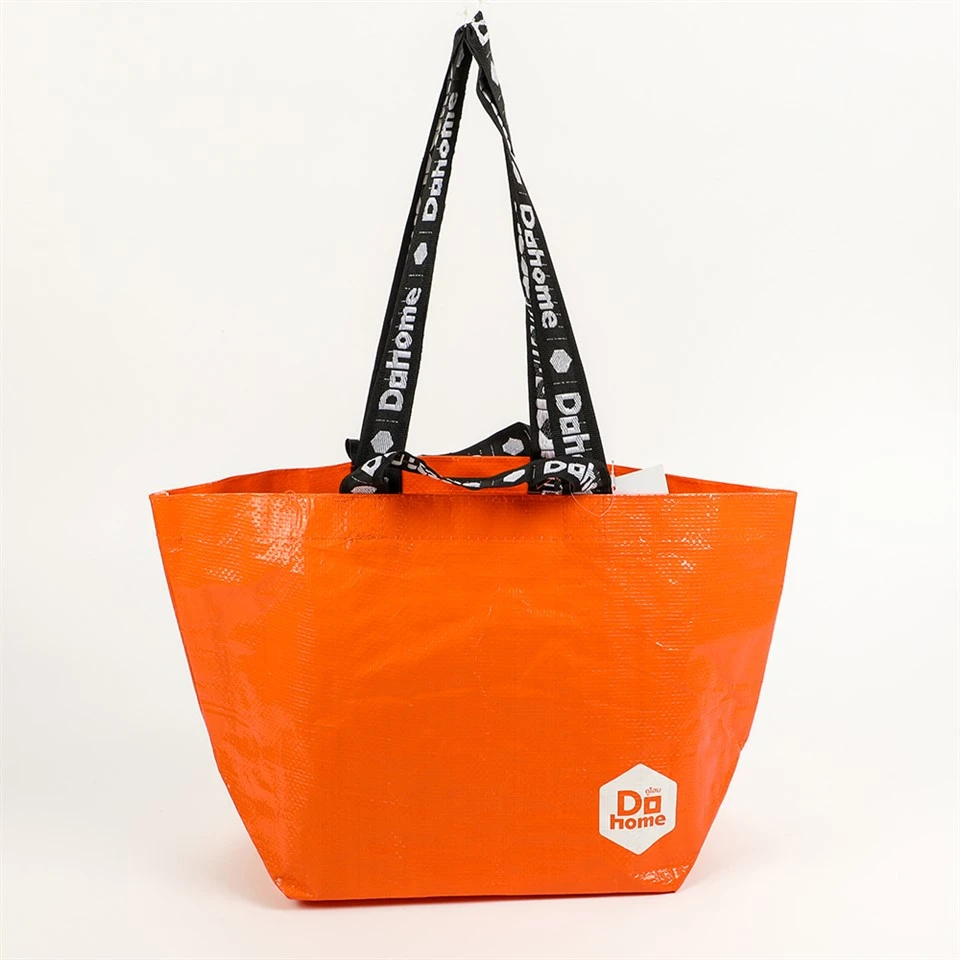
PP laminated woven bags are a polypropylene woven sack with a sheet of plastic on one or both surfaces. The woven fabric carries the load; the film provides moisture barrier, dust and printing surfaces. Three layers that determine the outcome - the webbing, the coating and the bond between them - bond, not the film, where most specifications are quietly lost. Capacity ranges from about 5kg to over 50kg.
What exactly does the Word "lamination" cover?
In supplier catalogues, PP Laminated Woven Bag can describe three different structures, and the price gap between them is real.
Extrusion coating. Molten polypropylene or polyethylene is extruded between the fabric and the film, or pressed directly onto the fabric and rolled in cold. Binding layer of 18 tie layer 30 g/m2 with no binder, no solvent, an all-polyolefin structure from recovery point of view.
Thin film lamination. Films manufactured individually --typically 15-35 15 – 35 μm usually biaxial polypropylene, with an actual optimum temperature of 18-25 microns --bind to solvent-or solution-free adhesives or already have a heat-activated coating on the film.
It's lined, not laminated. A loose polyethylene liner sits inside a plain woven bag. Nothing is glued, the lining migrates, it's not a printable surface. Buyers keep combining that with the patch.
The difference is important: the patch improves face value. It doesn't touch the seams.
From PP Pellets to Woven Fabric
The loading path starts with a flat sheet. Virgin polypropylene is molten, slit into strips 1.5-3mm wide, then stretched in a 5: 1-7: 1 ratio to align the polymer chains along the strips. This pull turns soft plastic strips into highly resilient yarn. Annealing was then carried out to prevent the tape from contracting, and additives-UV stabilisers, anti-skid agents and anti-blocking agents-were added to work at the scene.
Tape typically weighs between 800 and 1,200 dinars, and that number, rather than the weight of the fabric, is the true measure of its load capacity.
A circular or flat loom weaves tape into tubes of 8 × 8 to 14 × 14 at a rate of 10 × 10 to 12 × 12 threads per inch. Fabric weighs between 55 and 125 grams per squaremeter.
The overlooked specification is flatness. Uneven warp tension surfaces are later laminated as moles in printed images and tunnels or blisters. Weaving is the runway, laminating is the landing gear.
Three Routes to the Laminate
| Route | What makes this connection possible | Typical add-ons | Best for: | Key risks |
|---|---|---|---|---|
| Extrusion coating | Cold roller pressed into Molten PP or PE | 18–30 g/m2 | Large capacity, all-polyolefin structure | Needle holes or thin areas when roll temperature moves downwards |
| Adhesive lamination | Solvent-free or solution-based adhesive | 2–5 g/m2 adhesive plus 15–35 μm film | Matte, pearlescent or metallic finish; thermal film. | Residual solvent-Curing time before slitting |
| Thermosensitive films | Pre-coated film through laminators | 15-27 μm film, 5–12 μm adhesive layer | Short-term, existing laminating equipment | Lower peel strength than extrusion coating |
The numbers that will determine whether it stands
Five measurements can tell you if the PP Laminated Woven Bag will survive the real route, and all five can be included in the purchase order.
Stripping strength between film and fabric, as quoted at ASTM D903 per 15 mm Newton. Commercial targets are between 2.5 and 4.0 degrees /15 mm north latitude. Below roughly 2 N, the film is lifted at the first crease.
Surface energy, because polypropylene does not accept ink or molten polymers before treatment. Untreated tape was located near 29-31mN/m; corona treatment elevated it to 38–42 mN/m, and wetting tension was tested in ASTM D2578. The trap is decay-dealing with faded storage times and along the roll, so measured at the end of the roll.
Fabric strength, by grab tensile (ASTM D5034), tongue tear (ASTM D4533), dart impact (ASTM D1709) and pendulum tear (ASTM D1922, ISO 6383 -2). The fracture strength of the bottom seam is specified in Annex B. to ISO 23560.
Barrier, water vapour permeability at 38 °C and 90% relative humidity at ASTM F1249 and oxygen transmission permeability at ASTM D3985. A 20 μm polyethylene laminate, reduces the spread of moisture across the face by several orders of magnitude.
Friction coefficient, per ASTM D1894, usually adjusted to 0.3 -0.5. It's a number that keeps the pallet stack in a container, and it comes from a non-slip additive on the outer of the tape, not from laminate.
Printing under the Film
Most thin film laminate bags are printed in reverse: before bonding, the image is reflected onto the film, so the ink ends up trapped between film and fabric, protected by a full-film gauge. Pallet scuffing and truck-bed abrasion touched film surfaces, not art.
Rotation gravure or high resolution flexo high-definition flexo width of 800 – 1350 mm, mesh width of ± 0.15-0.25mm, and gravure color is controlled by ISO 12647-4 and flexo color by ISO 12647-6. Eight to 10 colour stations cover most of the brand's work; the tenth is usually a functional coat.
Matte and pearlised finishes are partitioned, not global: gloss is the hallmark of barcode scan.
Without adhesion test, printing requirements are worthless: tape testing under ASTM D3359 or cross-sectional testing under ISO 2409, plus the ink's food-contact status is separate from the film's contact state.
What the Lamination buying and what isn't
The PP Laminated Woven Bag buys a face, not a complete structure: moisture-and dust resistance, a printable surface, abrasion resistance, stack control and containers to stop fine powder escaping from the tissue. This is why fine powder, hygroscopic fertilisers and food staples move in this way.
What it doesn't buy:
Sealed seams. The laminate stops near the stitching line, so needle holes maintain continuous moisture and fineness channels, unless the seal is taped or heated.
UV protection. From the stabiliser in the tape. Unprotected tape can still be brittle in the sun.
Fabric strength. If weaving or denying is the wrong load, the movie fails. Layers hides a weak tissue until the tray reaches the dock.
High blocking. At 20 μm, oxygen and aroma transmission remain above the aluminum foil or EVOH structures, and adding laminates won't change that.
Heat resistance. Standard construction does not apply to hot filling or liquids; sealed windows and crease behavior are excluded.
The bags malfunctioned during use
Off the crease. The film first rises at the crease or in the corner of the tray-almost always a matter of surface energy when glued together. Field test: Thin film peeling under thumb pressure.
A cold crack in the folds. The crease cracks at low temperatures, presenting itself as a white line. The reason is film gauge or film chemistry, not adhesives; thicker films fix it, more adhesives do not.
Seam wicking. Moisture and fine powder passed through the stitch holes, leaving a darkened trail of stitch line and dust on the tray. The treatment is to close upgrade-folding the mouth with polyethylene tape, or stitching it up, and then sealing it with threaded hot tape.
UV embrittlement. After months outside, the tape cracked along its axis, and the sack tears along the tape rather than through it. The dosage of The stabiliser package is shorter than the service life specified by the route. Validation based on ISO 4892-2 or ASTM G154 accelerated weathering, in hours, with quotations against specified acceptance criterion.
overload. A 25kg to 40kg bag failed at the seams, not the film. A building without a 40kg reserve is a different product, not a cheaper one.
How to specify without getting burned
Naming standards and versions. ISO 23560:2015 for woven polypropylene sacks for bulk foodstuff of 25 kg and 50 kg, reviewed and confirmed as current products in 2025. EN 277 applies to woven polypropylene sacks for food aid.
Values measured using their methods were requested: N / 15 mm / ASTM D903, ASTM D3776 and ASTM F1249 to calculate water vapour permeability in terms of test conditions, drop and mass used, and UV hours calculated by lamp cycle. Test reports without date and condition are a requirement, not evidence.
Food exposure requires written documentation of the finished product, not resin: declaration in compliance with Regulation (EU) No. 1935 / 2004, FDA 21 CFR 177.1520 olefin polymers in the United States, and production hygiene requirements in compliance with EN 15593, in accordance with Regulation (EC) No. 10 / 2011. Ink and adhesive have their own customs declarations.
Samples are conducted in accordance with ISO 2859-1 and an acceptable quality level is indicated in the order. Then run your own drop test: drop 10 sacks to a standard position, stay in shape for 24 hours, and drop them from the height your route actually requires.
FAQ
Are laminated woven bags waterproof? Waterproof, not waterproof. The board is weatherproof and moisture-resistant, but the stitch line are not. A few hours of rain would do. Products that are soaked, left in a damp yard for weeks, or cake that is more than 60% relative humidity, must be taped or hot-sealed, and lining made mandatory.
How much weight has lamination added? Extrusion coating increased by 18–30 g/m2; a a 20 μm biaxially oriented film with adhesives increased by roughly 20–25 g/m2, resulting in a a 95 g/m2 fabric eventually approaching 115–125 g/m2. Compare total weight with denier prices, not just fabric weight.
Can I print directly on plain fabric? Yes, and cheaper. Surface flexographic printing directly affixed to the tape, suitable for industrial use, short shelf life, rough operation. The trade-offs are obvious: ink sits on tape ridges, fabric is displayed through letters, fine type degrades, and prints wear out wherever they touch the tray.
Overall, the PP Laminated Woven Bag has three decisions: the tensile ratio and denialism of the tape, the bond between film and fabric measured in Newton/ 15mm, and the degree to which the barrier you buy actually wraps around the product.
Source of information
- ISO 23560: 2015 -woven polypropylene sacks for bulk foodstuff (structure, requirements, test methods, Annexes A)
- EN 277 -Transportation of food aid bags, woven polypropylene fabric
- ISO 2859-1 -Sampling Procedures by Attributes
- ISO 4892-2 and ASTM G154 -Acceleration of weathering with xenon-arc and fluorescent apparatus
- ASTM D903 – Exfoliation strength of binders
- ASTM D2578 – wetting tension of polyethylene and polypropylene film
- ASTM D1894 -Static and kinetic friction coefficient of plastic film and sheet
- ASTM D1922, ASTM D1709 and ISO 6383-2 -Plastic film pendulum tear and dart impact resistance of free-fall darts
- ASTM D3359 and ISO 2409 --Adhesion of coating by tape test and cross-section test
- ASTM D3776, D4533 and D5034 -unit area mass, tongue tear and tensile strength of woven fabric
- ASTM F1249 -water vapour transmission rate through plastic film, modulated infrared sensor
- ASTM D3985 -Transmission Rate of Oxygen Through Plastic Film, Coulomb Sensors
- Process control for ISO 12647-4 and ISO 12647-6 gravure and flexographic printing
- (EC) Regulation (EC) No. 1935/2004 and Commission Regulation (EU) No. 10/2011 --food contact materials
- 21 CFR 177.1520 – olefin polymers